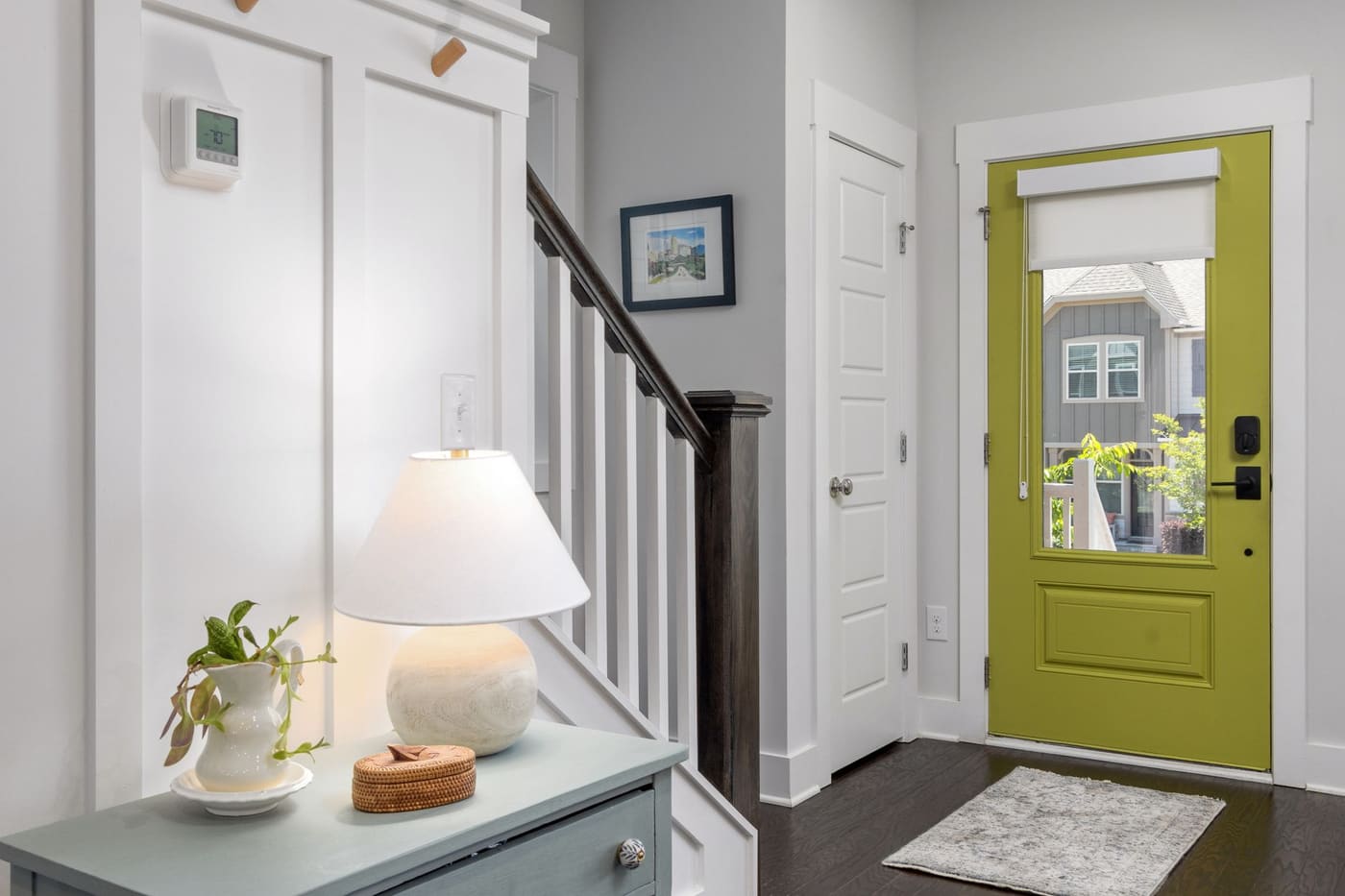
You decorate an entryway without cluttering it by limiting decor to a few deliberate pieces on one or two surfaces, keeping the floor and the main walking path clear, and choosing items that earn their place by being useful, beautiful, or both. A good target is three to five decorative objects in total, arranged so there is empty space around them, with everything else stored out of sight.
Entryways clutter easily because they are small, they get a lot of traffic, and everything arrives there first. Decor that would look fine in a living room becomes noise next to a pile of shoes and mail. The goal is not a bare space. It is a space where the decor is clearly the intended focus and the functional items are tucked away or styled to match. The sections below break down how to plan that.
Fix the function first, then decorate what is left
Decor on top of unsolved clutter looks like more clutter. Before you add a single object, make sure every daily item has a home: hooks for coats, a spot for shoes, a tray or drawer for keys, and a place for mail. If those are not settled, the new vase will end up holding receipts.
A quick test: stand at the door with a typical armload, such as a bag, keys and a jacket, and walk through the arrival routine. Whatever ends up on a surface is an item without a home. Solve that with storage, then see how much flat space is left for decor.
If you need ideas for the storage side, how to add entryway storage without making it look busy covers closed storage and wall zones in detail.
Use the rule of three to cap how much you display
Designers often group objects in odd numbers, and the entryway is a good place to apply it. On a console, shelf or narrow table, use one cluster of three elements at different heights. For example:
- A tall element, such as a lamp or a slim vase with branches, around 14 to 24 inches (35 to 60 cm) high.
- A medium element, such as a stack of two books or a framed print leaning against the wall.
- A low element, such as a tray or small bowl for keys.
Leave at least a third of the surface empty. Empty space is what makes the cluster look intentional. If you have more things you love, rotate them seasonally instead of displaying everything at once. Keep a small box in a closet for the extras.
Choose one focal point instead of several
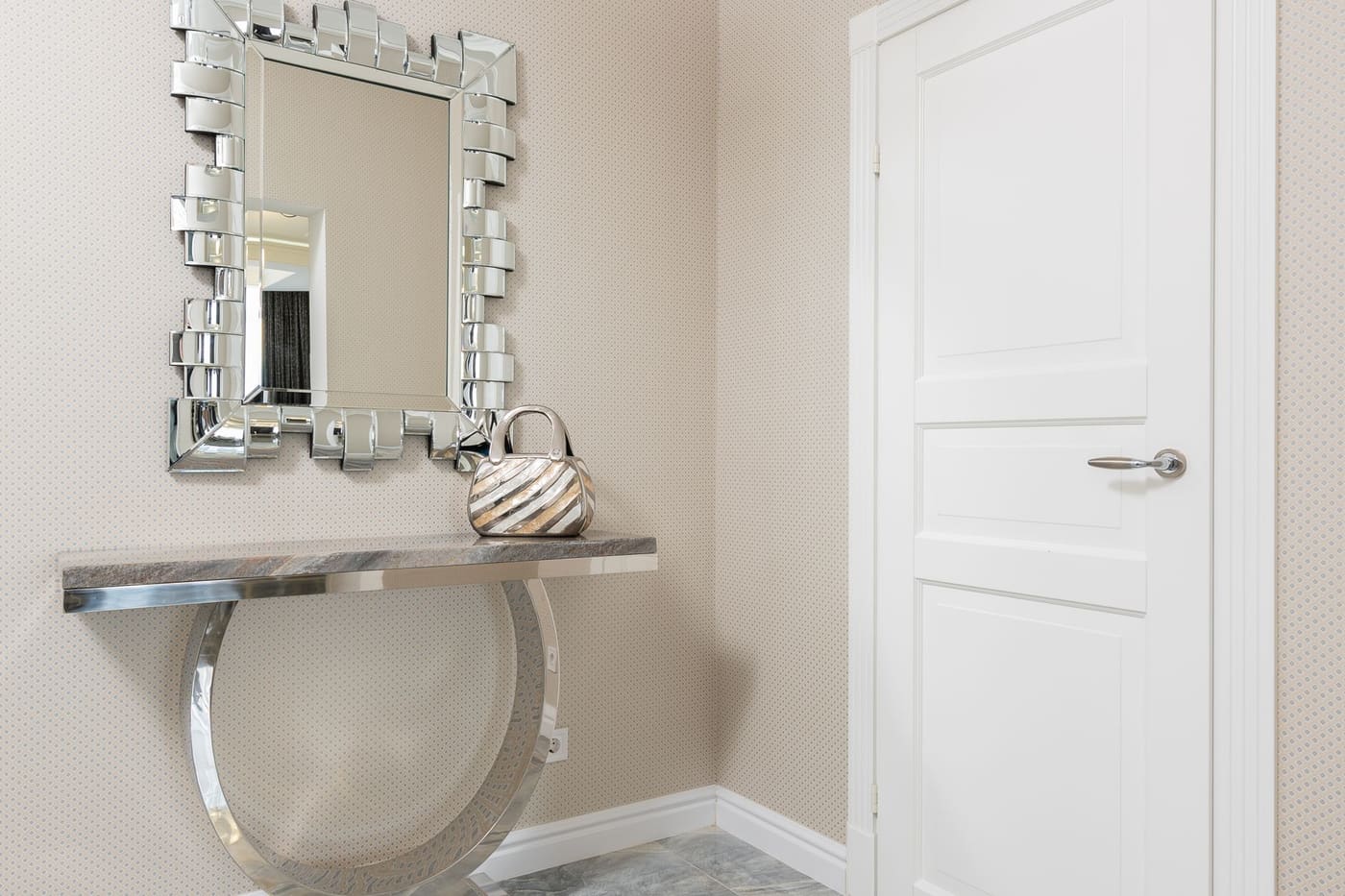
Clutter in decor usually comes from too many things competing. Pick one focal point: a large mirror, a single piece of art, a statement light fixture, or a bold wall color. Everything else should support it quietly.
- Mirror: A mirror at least 24 by 36 inches (60 by 90 cm) reflects light and makes a small entry feel larger. Hang it so the center is around 57 to 60 inches (145 to 152 cm) from the floor, which is a common gallery height.
- Art: One large piece generally looks calmer than a cluster of five small frames. If you want a gallery wall, keep the frames to one color and use even spacing of about 2 to 3 inches (5 to 8 cm).
- Lighting: A table lamp or a plug-in wall sconce adds warmth without taking floor space.
Do not stack a mirror, a gallery wall, a large wreath and a sign on the same wall. Choose one and let the others go.
Keep the palette tight
A small space reads as calmer when it uses few colors. Try a base of one or two wall-adjacent neutrals, one secondary color, and one accent. For example, warm white walls, natural wood, and black accents, with a single color such as green or rust in a plant, a pillow or a runner.
Repeat each color at least twice, so it looks planned. A black frame and black hooks, for instance, tie together. Odd one-off colors, such as a bright plastic bin, read as clutter, even if they are tidy.
Texture can do what color usually does. Wood, woven baskets, wool, ceramic and metal add interest without extra visual noise, as long as you keep to two or three of them.
Treat functional items as decor
The most effective way to avoid clutter is to buy functional pieces that look good, so you are not hiding them or adding extra decor on top. This applies to:
| Functional item | Decor version |
|---|---|
| Hooks | Solid wood or metal hooks in a row on a rail |
| Key storage | A ceramic dish or small wooden tray |
| Shoe storage | A closed bench or a woven basket |
| Umbrella holder | A slim ceramic or metal stand |
| Mail sorter | A single wall file in a matching finish |
When a hook rail looks good, you can leave coats on it without it looking messy. When a basket looks good, you can leave it in view. That shifts the entryway from hiding things to styling things, which is easier to maintain.
Use plants and greenery with realistic expectations
Plants soften a hard space, but an entryway can be dark, drafty or hot near the door. Check the light before buying. A spot with no window may only suit very low-light plants, and a spot beside a frequently opened exterior door in winter can be cold enough to harm tropical plants. If you do not have good light, a good quality artificial stem in a ceramic vase is a reasonable option, and a few branches cut from outside can look fresh for weeks.
Keep pots on a saucer or tray so water does not mark wood, and avoid placing plants where people will brush against them while carrying bags. Some common houseplants can be harmful to pets or children if eaten, so check the plant before bringing it home if that applies to your household.
Use the floor and ceiling carefully
A runner or rug anchors the space and hides wear, but a rug that slides becomes a hazard. Use a rug pad and choose a low pile so doors can open and close freely. A runner generally works best at 24 to 30 inches (60 to 75 cm) wide in a standard hallway, leaving a few inches of bare floor on each side. Washable or flat-weave rugs handle wet shoes and sand better than thick pile.
Overhead, a single fixture is enough. If the existing light is harsh, swapping the shade or bulb to a warmer color, around 2700K, softens the whole room without adding any objects. Changing a fixture that is hard-wired should be done by a licensed electrician, so stick to bulb or shade changes unless you are qualified and the power is off at the breaker. A plug-in lamp is a safer option for most people.
Maintain the look with a simple monthly edit
Decor clutter creeps in. Once a month, remove anything that has been added since last time and does not have a reason to be there. Check seasonal items too: a wreath that stayed up past its season starts to look cluttered. Wipe surfaces and straighten frames. The edit takes about ten minutes.
To keep it simple, follow a one-in, one-out rule: when a new decorative object arrives, an old one leaves. If you are looking to improve how the entry feels without buying a lot, what makes an entryway look more expensive without a big budget lists low-cost changes that have the biggest effect. Renters who cannot drill into walls can try the options in what renter-friendly entryway upgrades actually help.
Safety and mounting notes
Hang heavy mirrors and art with hardware rated for their weight, and use wall anchors or studs instead of relying on adhesive alone for anything large. Keep decor out of the walking path and away from the door swing. Leave the area around the door clear in case you need to leave quickly. In homes built before 1978, old paint may contain lead, and the EPA advises against dry sanding or scraping it.
Where this comes from
This article draws on common interior-styling rules of thumb (for example grouping in threes and gallery hanging heights, which are conventions rather than official standards), general guidance on rug safety, and the U.S. Environmental Protection Agency’s guidance on lead-based paint in homes built before 1978. It was reviewed on 2026-10-07 against those sources. Prices, product ratings and local rules change, so check current figures with the maker, your landlord or the named agency before you buy or build.