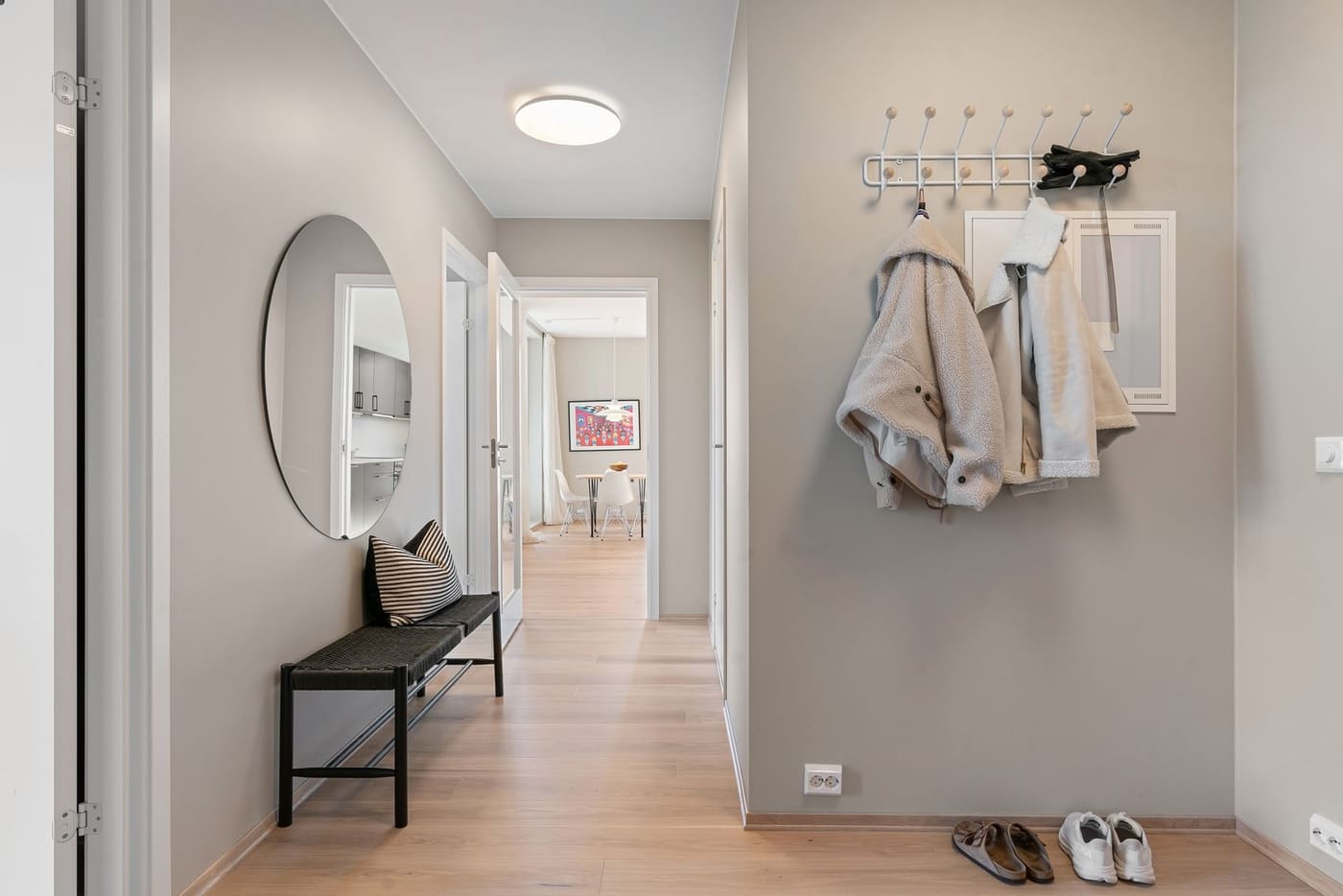
You add entryway storage without making it look busy by choosing closed or visually quiet storage, keeping everything in one or two matching materials, and giving each item a single assigned spot so nothing spills onto surfaces. The look of “busy” comes from variety and visible stuff, not from the amount of storage itself, so a well-planned wall can hold more than a cluttered one and still look calm.
Most entryways get busy in a predictable way. Someone adds a hook rail, then a basket, then a tray, then a shelf, each in a different finish, and every piece holds a different mix of objects. The fix is to decide what truly belongs by the door, pick storage that matches that list, and repeat a small number of materials and colors. The sections below cover how to do that step by step.
Start with a list of what actually lives by the door
Before you buy anything, collect every item that currently gets dropped near the entrance for one week. Put it on a list and sort it into four groups: worn daily (coats, bags, shoes), carried daily (keys, wallet, phone), occasional (umbrellas, hats, gloves, dog leash), and things that do not belong there at all (mail piles, library books, packages, tools).
The first three groups define your storage. The fourth group needs a home elsewhere, or it will keep colonizing the space. A good rule is to plan for the current household, plus one extra coat hook per person for guests. If four people live in the home, a rail with six or seven hooks is usually enough.
When the list is short, the storage can be short. Many busy-looking entryways are simply holding items that never needed to be there.
Choose closed storage for anything that varies in shape
Visual noise comes from irregular shapes. Shoes, hats, gloves, dog gear and reusable bags all look messy when exposed, even if they are neatly arranged. Anything with a changing outline should go behind a door, inside a lidded bin or into a drawer.
- Closed cabinets or benches with doors: Best for shoes and bulky items. A shallow shoe cabinet runs about 8 to 12 inches (20 to 30 cm) deep and tilts or folds so it does not stick out far.
- Lidded baskets or fabric bins in a solid color: Good for gloves, hats and scarves. Use bins of the same size and color so they read as one block.
- Drawers: A single shallow drawer in a console holds keys, masks, chargers and small tools without any of it showing.
Open storage still has a place, but treat it as display. Put only the things that look good together there, such as one tray, one lamp and one plant, and keep daily clutter inside the closed pieces.
Use the wall, but limit it to one organized zone
Walls are the cheapest place to add capacity, and also the easiest place to overdo it. Concentrate wall storage in one zone instead of spreading small items across the whole wall.
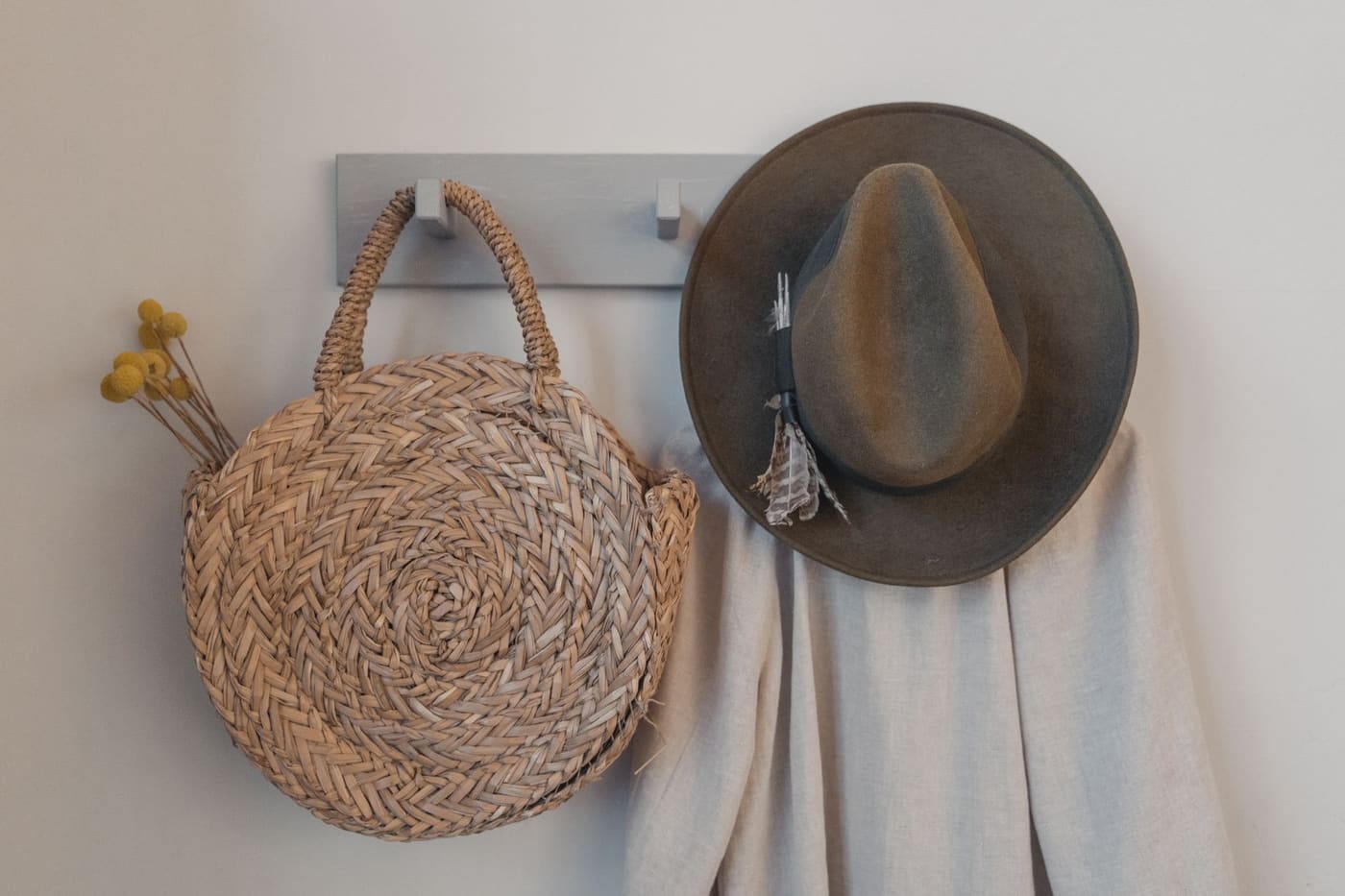
A single horizontal hook rail mounted at about 66 to 72 inches (167 to 183 cm) from the floor works for adult coats. Add a second row lower, around 40 to 48 inches (100 to 120 cm), for children’s jackets and bags. Space hooks roughly 6 to 8 inches (15 to 20 cm) apart so coats do not overlap into a bulky clump.
Keep the rule of one coat or bag per hook. A hook with three jackets stacked on it looks messy, and it usually means you need a seasonal swap: store off-season outerwear in a closet or under-bed bin and keep only what is in use.
If you are renting, check the lease before drilling. Many rails can be mounted with removable adhesive strips rated for the weight, though heavy coats and wet winter jackets can pull strips loose. Read the weight rating on the package, and use screws into studs only where the lease allows it.
Repeat materials and colors to keep it calm
Matching does not mean everything must be identical. It means the eye should find only two or three materials in the whole zone. A common combination is painted wood, black metal and woven natural fiber.
Try this simple set of limits:
- Pick one main color for large pieces, close to the wall color so they recede.
- Pick one accent material, such as warm wood or black metal, and use it for hooks, handles and frames.
- Choose one texture for soft items, such as woven baskets or a wool runner.
- Keep everything else the same neutral tone as the wall.
Painting a bench or cabinet the same color as the wall is a quiet trick. The furniture still works, but it stops competing for attention. Satin or semi-gloss paint wipes clean more easily than flat paint in a high-traffic area.
Give each item one spot, and size that spot honestly
A busy look usually comes from overflow. Storage that is too small forces items onto the nearest flat surface. Measure what has to fit before you buy.
| What you store | Typical space needed |
|---|---|
| Pair of adult shoes in a cabinet | about 4 to 5 inches (10 to 13 cm) of width each, tilted |
| Coat on a hook | 6 to 8 inches (15 to 20 cm) of rail width |
| Keys, wallet, sunglasses | a tray roughly 8 by 10 inches (20 by 25 cm) |
| Bags and backpacks | one dedicated hook or bin each |
| Umbrella | a slim stand about 8 inches (20 cm) across |
Limit the number of pairs of shoes by the door to what the household actually wears this week, often two or three pairs per person. The rest can go in a bedroom closet. This single limit does more for the look of an entryway than any organizer.
Hide the small stuff with a landing spot
Keys, mail and sunglasses are the items that sprawl. Give them one contained home, such as a shallow tray, a small wall pocket or a drawer, and sort mail right away over a recycling bin or into a single slim file slot. A tray works because it turns scattered objects into one object.
If you need a place for charging devices or packages waiting to go out, put a lidded box under a console. Avoid adding extra containers for each small category. Three small containers on a shelf look busier than one tray with items in it.
Control height and depth so nothing juts out
Bulky storage in a narrow hall reads as crowded. Keep floor pieces shallow, ideally under 12 to 14 inches (30 to 35 cm) deep in a hallway that is under 4 feet (1.2 m) wide. Leave at least 36 inches (91 cm) of clear walking space where possible, because a tight passage makes any entry feel messy even when it is tidy.
Lift furniture off the floor when you can. Wall-mounted shelves and floating benches show more floor, which makes the space look larger. If you mount anything heavy, use hardware rated for the load and anchor into studs or proper wall anchors.
A weekly reset keeps the system quiet
Even a good setup gets busy if nothing is returned. Do a two-minute reset once a week: put shoes back, empty the tray, hang up anything on a chair and pull out mail that does not need to stay. Having a recycling bin or basket nearby makes this easier. For help building habits around this, see our guide on how to stop an entryway from becoming a dumping ground.
If shoes are your main source of mess, the options in what shoe storage actually keeps an entryway tidy will help you pick a format that fits your habits. When the space itself is small, how to make a tiny entryway more functional covers layout choices in more depth.
When to call a pro
Most entryway storage is simple DIY. Ask a professional if you need to cut into a wall, move an outlet or light switch, or mount something heavy over a staircase. Electrical changes should always be handled by a licensed electrician. Homes built before 1978 may have lead-based paint. The EPA advises against dry sanding or scraping it, so if paint is chipping, follow the EPA’s lead-safe guidance or use a lead-safe certified contractor.
To work out how many hooks and shelves your household needs, use the entryway storage capacity calculator.
Where this comes from
This article draws on general home-organization practice, common design rules of thumb for hook heights and clearances (these are conventions, not official standards), and the U.S. Environmental Protection Agency’s guidance on lead-based paint in homes built before 1978. It was reviewed on 2026-10-07 against those sources. Prices, product ratings and local rules change, so check current figures with the maker, your landlord or the named agency before you buy or build.